© Annemarie Oechslin

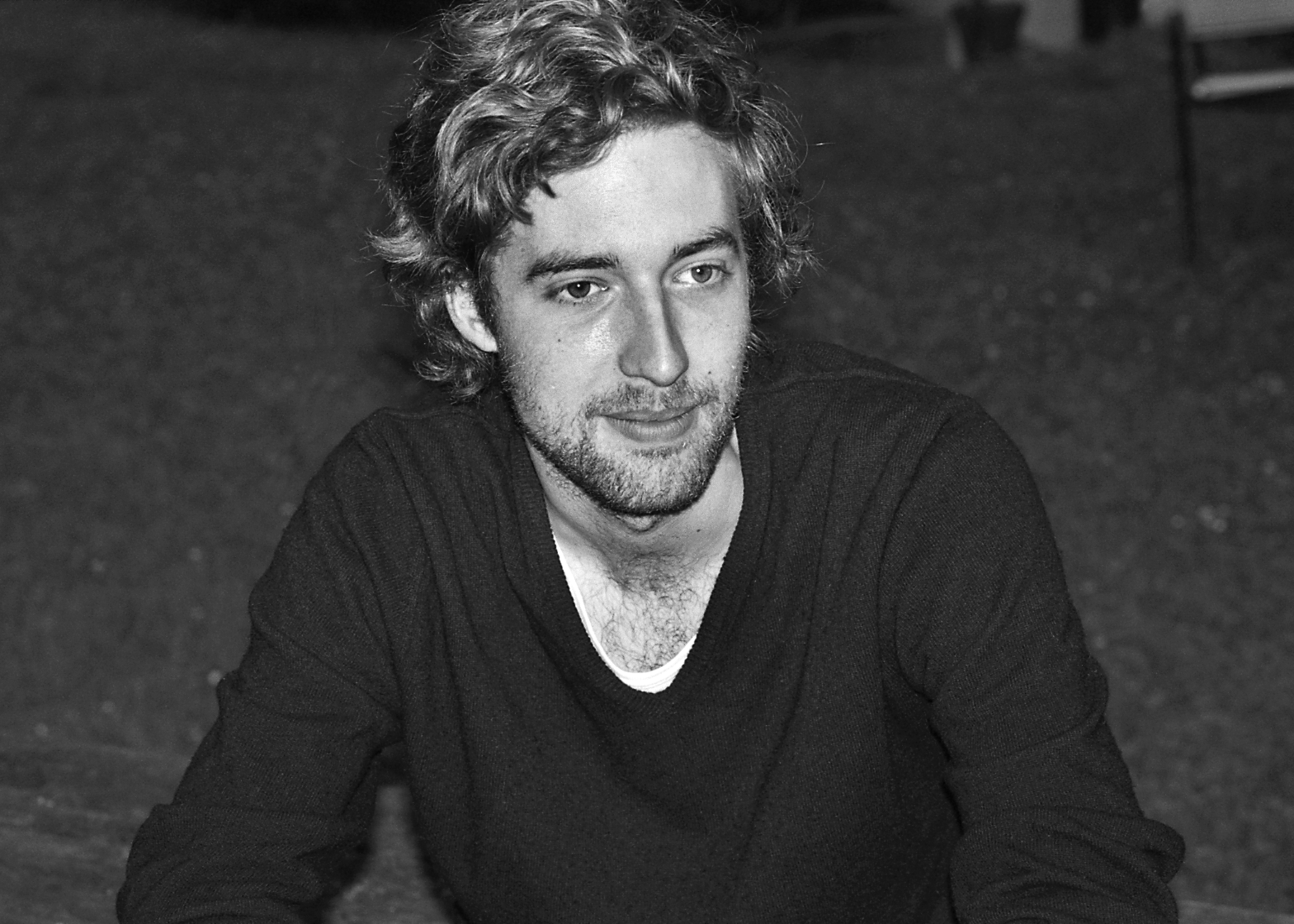
Lorenz Langenegger

Lorenz Langenegger, born in 1980, lives in Vienna and Zurich. He studied Theatre and Political Science in Bern where he wrote his first plays for the theatre. Since 2004, he has had several commissioned plays. In 2005, Lorenz Langenegger participated in the Swiss Masterclass MC6 and in 2006 in the Young Authors’ Programme Dramenprozessor. Here the play Nah und hoch hinaus was written which had its world premiere at the Nationaltheater Mannheim in March 2008. He won the drama competition of the Schaubühne Berlin with Rakows Dom in 2006. In the summer of 2007, he took part in the International Residency of the Royal Court Theatre in London.
In the spring of 2009, he published his first novel Hier im Regen with which he participated in the Ingeborg-Bachmann-Preis in the summer of the same year. In 2012, he was invited to the Authors’ Workshop of the Burgtheatre Vienna with his play Wo wir sind. With the same play, he also participated in the Heidelberger Stückemarkt in 2013. In 2017, he took part in the Heidelberger Stückemarkt again with his play Nord West 59 which will have its world premiere in December 2017 at the Theater Regensburg. His second and third novels were published in 2014 (Bei 30 Grad im Schatten) and and 2016 (Dorffrieden).

Awards:
2009 Literature Prize of the Canton Bern for Hier im Regen
2009 Franz Tumler Literature Prize for Hier im Regen
2012 Prize of the Swiss Authors’ Association (SSA) for Wo wir sind
Lorenz Langenegger, born in 1980, lives in Vienna and Zurich. He studied Theatre and Political Science in Bern where he wrote his first plays for the theatre. Since 2004, he has had several commissioned plays. In 2005, Lorenz Langenegger participated in the Swiss Masterclass MC6 and in 2006 in the Young Authors’ Programme Dramenprozessor. Here the play Nah und hoch hinaus was written which had its world premiere at the Nationaltheater Mannheim in March 2008. He won the drama competition of the Schaubühne Berlin with Rakows Dom in 2006. In the summer of 2007, he took part in the International Residency of the Royal Court Theatre in London.
In the spring of 2009, he published his first novel Hier im Regen with which he participated in the Ingeborg-Bachmann-Preis in the summer of the same year. In 2012, he was invited to the Authors’ Workshop of the Burgtheatre Vienna with his play Wo wir sind. With the same play, he also participated in the Heidelberger Stückemarkt in 2013. In 2017, he took part in the Heidelberger Stückemarkt again with his play Nord West 59 which will have its world premiere in December 2017 at the Theater Regensburg. His second and third novels were published in 2014 (Bei 30 Grad im Schatten) and and 2016 (Dorffrieden).

Awards:
2009 Literature Prize of the Canton Bern for Hier im Regen
2009 Franz Tumler Literature Prize for Hier im Regen
2012 Prize of the Swiss Authors’ Association (SSA) for Wo wir sind

Theatre

Audio

Lorenz Langenegger

Geschwister

3 F, 1 M

Gabriela: "I have a child. I am married. I have a job. An apartment. I - "
Tom: "At last we can be a real family."
Maja: "Now you are running away. Very good. Really really good. What a family! "
Doris: "That's just how I am. That's all. You mustn’t expect too much. "

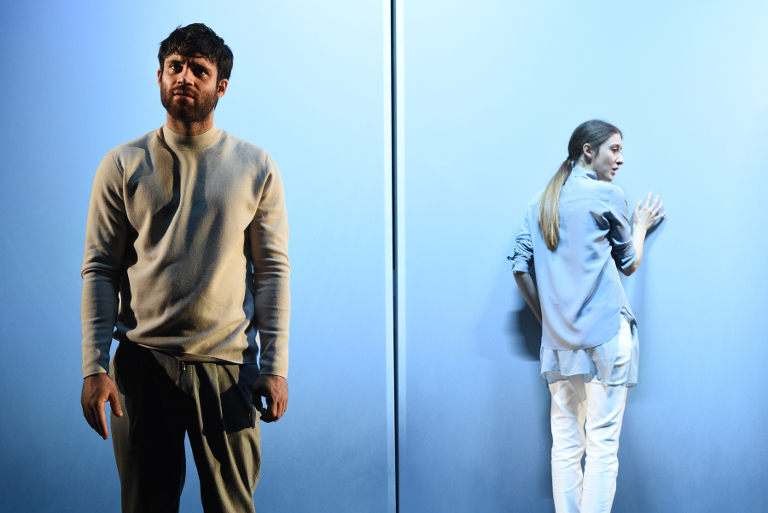
In the middle of the night Gabriela finds a stranger in her bed. He turns out to be her brother Tom, whom she has not seen for thirty years. How did Tom get into the apartment? Why did her daughter Maja let him in? In the following, we watch how Tom forces his way into Gabriela's life in a sequence of scenes that intersect many layers of time. On the street, he meets Doris for the first time. The door to the apartment on the twenty-first floor is opened by the fifteen-year-old Maja, and Gabriela asks Doris to come into to the living room. Finally, Tom and Gabriela meet in the intimacy of the bedroom. But gradually the mosaic collapses.
At eighteen, Tom left home, leaving the parents he had never believed were his own. He fled from his fifteen-year-old sister, Gabriela, for whom he had fierce feelings. Decades later, the financial crisis ends his career as a banker and he takes up the search for his real parents. In the addict Doris, he claims to have found his mother. And now he is there to convince Gabriela that he is not her brother and there are no obstacles to their love.

Family - ties, expectations, trust and closeness, but also separations, deception, distrust and distance - Lorenz Langenegger 's new play illuminates this complex of topics and thereby holds many things in the balance.

Theatre

Lorenz Langenegger

Kreuzfahren

2 F, 2 M

Four people meet on a cruise ship to Greece and join up in groups of two on the ship’s deck. Three are trying to escape their own lives. There is the young man who got cold feet three days before the wedding and is now taking his honeymoon trip alone. And the elderly man who has left his family because of a young woman who does not want to know anything about him. And the older woman who lost her husband three months earlier. Only one young woman has an end goal in sight: she is on the ship to travel to Patmos, where her German boyfriend is working in a hotel and is waiting for her.

The dialogues between the characters are initially distinguished by the fact that everyone talks only about himself, is not heard by the others and does not listen to them. In the ensuing sequence of one-on-one dialogues, they meet more openly, begin to get to know each other, to give things away. But the talks always end noncommittally. The end of the journey is also the end of their relationships; everyone goes back to their life alone.

The time after the cruise is over is present throughout the play. Deferred, retrospective monologues, in which the four travelers reflect on their subjective perception, make reference to the future. In the end, each figure will claim to have found happiness.

"The characters take us on a treasure hunt through biographies which are not unlike our own, in pieces that trace criminal psychograms without wrongdoing as if they were on the drawing board." (Ann-Marie Arioli, Stückwerk 4, deutschschweizer Dramatik, Theater der Zeit)

Young Theatre

Lorenz Langenegger

Nordwärts

1 F, 3 M

Nordwärts is about longing and wanderlust, but also about fate and self-determination. Two brothers are on the road in Scandinavia. After the death of their mother, they are looking for their father—and they end up finding themselves.

"The North Pole was the summit of all desires, the mother placed everything else below this goal. She took detours, made compromises to realize her life. Nevertheless, everything was different than she had imagined. She fell in love with the Norwegian forests, became pregnant and had to decide between the north and her family. The North Pole remained a dream. Her diary was the only thing holding onto that dream. Before the eyes of her twin sons, however, she made the dream come true, recalled and narrated never-lived adventures, and even gave a special aura to the father’s absence from the family.
The brothers have different end goals, but even this is the result of their emancipation: ... Robert frees himself from the father-image shaped by his mother and looks for family connections of his own. Thomas asks questions about his mother's longings and disappointments, and along the way finds another goal: the North Pole itself, the destination of his mother. " (Announcement Theater at the Sihl, Zurich)

"In doing so, Langenegger succeeds in never becoming moralizing or heavy. The text skillfully intersperses different layers of time ... the short sentences are clearly set. The play begs for an abstract production.” (Tages-Anzeiger)

Theatre

Lorenz Langenegger

Rakows Dom

3 F, 4 M

"Lorenz Langenegger wins the play competition of the Schaubühne.. The jury ... praises the striking dramaturgy and the economic language of Rakows Dom. The characters are, in the opinion of the jury, strongly drawn, and Langenegger succeeds in a humorous portrayal of the cosmos of a small-town society... Rakows Dom describes the madness of the faith in money and power, the absurdities of political mechanisms, and the great repression of a family lie. " (Press release Schaubühne Berlin)

In past centuries, rich and powerful families built castles or churches. Today they collect art, begin charitable foundations which try to do something about the misery of the world, host a football club or win sailing competitions. But what if a man wants to build a cathedral today? Is this a great idea, one that opposes small-minded resistance, or is it rather a matter of overweening arrogance—one which must be stifled in the bud? Why is the pastor opposed to the new house of God, and why do the artists support it, even though their ateliers must give way to the splendor? Mrs. Rakow and the city mayor support the project from a professional standpoint.
The delicate Junior misses his sister, Jelena, blames his father for sending her to a sanatorium, and does not show much enthusiasm for the plans of his parent. The girl from the College of Art, on the other hand, has retained her artistic virginity for a work of such proportions and is determined to fulfil Rakow's desire that she marry Junior in what will be the opening ceremony of the century. And all this, only because I wanted to write a play about someone who wants to build a cathedral because he has a thing for domes. (Lorenz Langenegger)

In the context of the 7th International New Dramatic Festival (F.I.N.D.7) of the Schaubühne, the play was presented in a scenic reading arranged by Sebastian Nübling.

Theatre

Audio

Lorenz Langenegger

Wo wir sind

3 F, 3 M

A city park at night. Six residents of the city are spending time there for a variety of reasons. Markus, who works too much, and until late in the evening, meets once a week with Amir at the pond. Amir, on the other hand, has too much time. He is not allowed to work, but his family in his home country is in dire need of money to pay a lawyer to find his imprisoned sister. Last summer, he met Lena, who was enjoying her holidays with a friend on the Mediterranean.

Lena persuaded her friend Bastian to pack their tent and sleeping bags so that they could join the protest in the park. Bastian is a paramedic and does not understand what happened to his girlfriend, and why she is constantly being called by Amir, even though she claims to barely know him.

Bastian walks away and meets Sabine, who is looking for Markus, because their joint son is in the quarantine station of the local hospital with an infection. Sabine fears losing her husband. Since the birth of the child, Markus' worries are spinning out of control. His professional analyses penetrate the private sphere. He wants to build a safe harbor for his son, a net that will catch him when all else fails.

Anna sometimes gets her times of day mixed up, and so she goes for a walk at night. After the death of her husband, who worked for the Ministry of Foreign Affairs, she lived alone in the apartment with a view of the park. Until she fell on the street and Amir helped her up—Amir, who needed a roof over his head for the cold season.

Did Lena decide? Who killed Markus? Why does Amir already have a new phone number? Has Sabine been infected by her son? The characters are caught up in a finely knitted network of dialogues. One door opens the next. Rooms open - and abysses. There are no certainties. All these encounters invite different interpretations.

Production history

Digitales Textbuch