Theatre

Gerhard Meister

Lauter vernünftige Leute

1918 – not a good year in Europe: The continent is in a state of turmoil and dissolution, the Habsburg monarchy has broken down and nobody in Austria knew how the young republic would develop. Whether it was viable at all. This lack of orientation also reigned in Vorarlberg, as well as a great famine which could only be ameliorated a little by aid from Switzerland. In this situation, the Lustenau teacher Ferdinand Riedmann put himself at the front of a movement which had as its aim to initiate talks with Switzerland about accession to the country. In May 1919, there was a plebiscite: 80,7% of the Vorarlberg population was in favour. However, Switzerland gave a cold shoulder to the poor neighbours, and the Allies also refused the desire: Many borders were newly drawn, but Vorarlberg remained with Austria. A hundred years have gone by since those restless days; Europe has become much more unstable again, is being challenged more than we thought possible during the last decades. A good moment to throw a double glance back and forward – and across the border: An Austrian and a Swiss dramatist write a play each for this double evening. Two neighbouring countries, two writers of different generations, two different perspectives on the “Kanton Left-over” – which was the nickname for Vorarlberg after the failed approach which is regarded differently perhaps from a Swiss perspective today. (Announcement Vorarlberger Landestheater Bregenz)
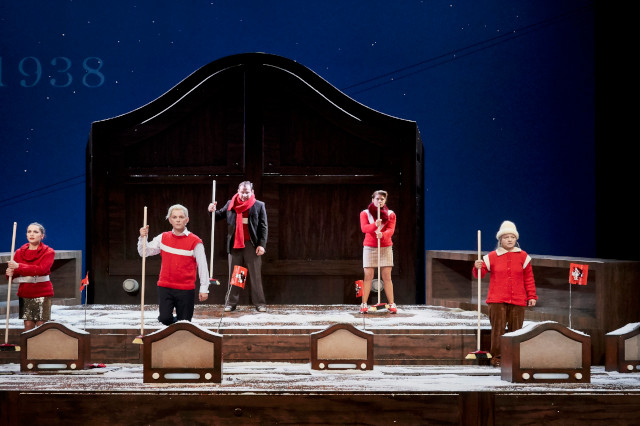
Auftragsarbeit für das Theater Bregenz

3 F, 3 M

World Premiere: 08.03.2019 · Vorarlberger Landestheater Bregenz · Directed by: Patricia Benecke

Production history

All Premieres
08
März 2019
Gerhard Meister

Lauter vernünftige Leute

Theatre

UA

Directed by Patricia Benecke

More plays

All plays

Theatre

Gerhard Meister

Stilleben Herr mit Kätzchen

1 M

"Yeah, you should get your comedy. Or perhaps a fairy tale? Whatever. Anyway, in the leading role there’s a lonely poet at work on his manuscript." Once upon a time there was a lonely poet sitting over his manuscript and forcing out verse after verse. The work was laborious, and becoming more laborious. Who was that Nathan, whom he had sweated out line by line, and what did this Nathan have to do with himself, the old, deadly illl man who had grown bitter? What, for God’s sake, was he doing there? And for whom was he doing it? He could do nothing more with this Nathan. He had gotten up again and again, enough already. Had hidden away the death of his wife and child in his heart, and his own sick body, and the censorship. Now it was no longer possible.

How had he ever pinned the murder of his wife and children on Nathan and then do what with him? Guess. Hide away. Who hides something like this? Who the hell was as wise as Nathan? He wasn’t anyway, that was more and more clear. And this Nathan, what was he then? A rickety marionette, on whom he had painted a wise face, verse by verse. Enough."

Stilleben Herr mit Kätzchen was created as commission for the Staatstheater Braunschweig and was presented to the public for the first time in a workshop production on the occasion of the 275th birthday of Gotthold Ephraim Lessing. This contemporary approach to the classical author offers an ideal frame for the productions of his original plays.

Theatre

Gerhard Meister

Mieschers Traum

1 F, 2 M

Friedrich Miescher, who became a pioneer of genetic research through his discovery of nucleic acid in 1869, fell ill with tuberculosis at the age of fifty. He spent the last one and a half years of his life in the lung hospital of Doctor Turban in Davos.
Miescher's failure due to his early death and his unfinished work is the starting point of this play, and of the dream which penetrates the solitude of the sick-room more and more deeply.

Short, minimalistic scenes between the doctor, the patient and the nurse Anna reflect the monotony of the patients' day in constantly recurring dialogue sequences. Scaffold-like, they hold the piece together. At first, the scenes are written by Anna, in her letters to her distant lover. Thus, she still maintains contact with life outside the hermetic world of the sanatorium. Later on, Miescher's dreams or fever delusions increasingly determine the progress of things, and testify to his unstoppably advancing disease.

Contrary to his own maxim, the pragmatist Turban comes more and more under the spell of the theorist Miescher. More and more, he encourages him to ask questions about his research. As the distance between the doctor and the patient gradually disappears, Anna falls deeper and deeper into the maelstrom of her relationship with Miescher.

His death at the end of the play means not only his own tragic failure in his unfinished work, but also that of the doctor. And Anna writes to her beloved that he must forget her. She will not leave Davos.

Mieschers Traum came about as part of the Dramenprozessor, a project for young Swiss authors. It was presented in June 2002 in a scenic reading at the Theater an der Winkelwiese in Zurich.

Theatre

Audio

Gerhard Meister

Der Entenfreund

3 F, 3 M

Who hasn’t had the idea before: I’m stopping here, I’m done with everything, I'm not going to go on anymore. Of course you don’t carry through with it. You are rational and don’t want to lose everything you have and everything you have tried to believe in: career, family, future. Gerhard Meister's latest play has an absentee in its center, one who stood up from his workplace and, from one moment to the next, left behind his career, family, and future - to feed ducks. Der Entenfreund revolves around a missing person who does not speak himself, but who is present in the conversations which are carried out between his wife and a childhood friend, his superior, and his successor; then there is also the woman from the company who talks about him as if he were her lover, and a man who is busy with the extermination of vermin, to which, in his mind, the duck friend belongs more and more.

In this play, Gerhard Meister sketches the portrait of a man in dialogues and monologues. From different perspectives and different lives, different images of a completely fascinating man arise. Through his inexplicable behavior, the apparently self-evident way of life of the others falls apart under the pressure to explain itself.

In September 2004, Der Entenfreund was honored with the special prize of the Société Suisse des Auteurs. Gerhard Meister wrote the play in the 2003/04 season whilst on a scholarship of the Kunststiftung Baden-Württemberg.

Theatre

Gerhard Meister, Romina Paula

Fiktionland

4 F

"Rosa was born in Argentina. She has lived there all her life. Rosa's mother died. Rosa does not know her father. The only thing she possesses from him are a few photo slides. He is probably a German. Rosa is considering the possibility of looking for this man, to get to know him. Rosa has never been to Europe, and neither have Bárbara, Evangelina and Raquel. All that they know of the First World is what they have heard somewhere. Or read. Now they intend to give Rosa advice. Is there such a thing as belonging? Is it possible to have roots and an inheritance? Is there an older and more stable First World? In no case, however, can there be a space which is free of discourse. And when the earth belongs to the Father (Fatherland), language belongs to the Mother." (Romina Paula)

"This play is about the images and ideas that we have about ourselves and about strangers. The stranger is longed for and feared, he is both daydream and nightmare. But what do we know about ourselves and and about strangers? To what extent do these images and ideas refer to a truth that is hidden, and to what extent do they produce this truth? In a kind of laboratory situation, four women go on a research trip that confronts them with such pictures and stories. At the center is Rosa Tureo, a young Argentinian in search of her German father, whom she has never seen before." (Gerhard Meister)

The play was created within the framework of DRAMATURGIAS CRUZADAS (directed by Erik Altorfer and Hartmut Becher), with the support of the Swiss Cultural Foundation Pro Helvetia and the Goethe Institute in Buenos Aires. The workshop production of the preliminary version took place in Espacio Callejón in Buenos Aires on 6 September 2010 and was directed by Romina Paula.

Digitales Textbuch