Young Theatre

Maria Milisavljevic

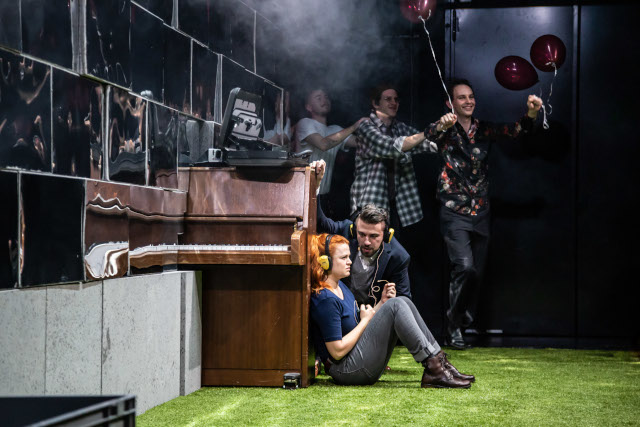
Das schaffen wir! Oder: Einer hat die Absicht eine Mauer zu bauen.

"So much for your freedom of choice. Now I decide and you will do as I say. Here it is: the first stone. Jesus Christ, what are you doing? I told you not to throw it. Now put your arm down. That was not my intention. Throwing stones and waving them around. Put your arm down and smile. History. Never forget history. Otherwise, in 50 years, they'll say we didn't know what we were doing. If we hadn't known better, but we do know exactly what we're doing. Now pick up the stone again and put it over here. Here, where I'm standing. Looks nice, doesn't it? And how does it feel to be part of something big?"
On the occasion of the 30th anniversary of the fall of the German wall and reunification, Maria Milisavljevic confronts the audience with a self-proclaimed representative who has the intention to build a (no) wall. With cuttingly precise language and an analytical eye, she presents the thought patterns and ideological rhetoric that make it possible to build walls again and again, and also shows us our own limits in thinking. A political play for young people, which makes us painfully aware that the erection of walls is no unique historical event, but has lost nothing of its current explosive power.
für das Theater Regensburg

4 Performers

World Premiere: 29.02.2020 · Junges Theater Regensburg · Directed by: Maria-Elena Hackbarth

Production history

All Premieres
29
Februar 2020
Maria Milisavljevic

Das schaffen wir! Oder: Einer hat die Absicht eine Mauer zu bauen.

Young Theatre

UA

Directed by Maria-Elena Hackbarth
Theatre Theater Regensburg, Regensburg

More plays

All plays

Theatre

Maria Milisavljevic

Peer Gynt (she/her)

6 F, 4 M

Peer Gynt - narcissist, bon vivant, liar: in his "Nordic Faust" Henrik Ibsen tells the biography of an egomaniac in many stages, which could also have originated in our present-day society in its basic features more than 150 years later. For this reason, the Regensburg Theatre has commissioned its in-house playwright Maria Milisavljevic to write a version of the material from today's perspective.

Peer Gynt is human. And in the 21st century, Peer is also a woman. A woman who lies. Again and again. With the wildest stories, she dreams herself away from her bleak life, in which her father destroyed the family's livelihood in drunkenness and her mother abandoned Aase and her in misery. She longs for fame and recognition, yet everyone only smiles at her. There is no place for her in the village - because she refuses to be instrumentalised by society as a woman. The more rejection she feels, the more imaginative her lies become, with which she escapes all family and social obligations. After Aase's death, she is not only guided by the motto of her life, "Be sufficient unto yourself", but is literally driven through the world in a life-hungry and manic search for herself, constantly oscillating between essence and appearance. Those who are always true to themselves must inevitably disappoint others.

But what remains in the end, after a seemingly dazzling life as an outsider? Where to go with the fear of mediocrity, the addiction to self-dramatisation and the constant search for affirmation and love? (Announcement Theatre Regensburg)

"Seeing Peer Gynt, this egomaniac who takes everything for himself, interpreted as a woman's role has an effect, brings to light the still encrusted gender attributions." (Süddeutsche Zeitung)

Digitales Textbuch