Theatre

Caren Jeß

Die Katze Eleonore

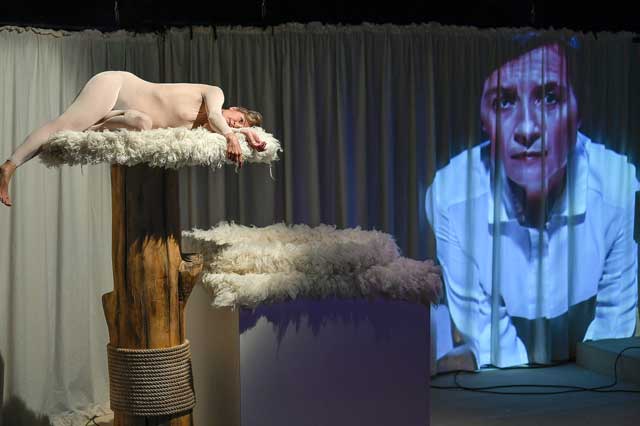
Eleonore is a woman. Until one day she realises that she is actually a cat. Because she is financially independent and single, nothing really stands in the way of her transformation. She has a cat-skin suit sewn for her and gradually dehumanises her eating, sleeping and social behaviour. In head conversations with Dr. Wildbruch, a therapist who is fascinated by her feline behaviour, it becomes clear that Eleonore's thinking also increasingly resembles that of a cat. Her distancing from human modes of perception, which are far from rivaling those of a cat, is so comprehensibly described that the transformation of her life sounds far more than understandable. One might even say enticing.

At the same time, Eleonore is caught in the impossibility of actually being a cat as a human being. Biology cannot be outwitted, despite all the adaptations. Nevertheless, she adapts as much as possible. In the end, her life consists only of hunting mice in the garden and sleeping, a reduction to instinct and drive. Eleonore's monologue tells the story of how her senses expand and society becomes absolutely irrelevant, with a language that in its delicate poetic precision comes very close to the essence of a cat - despite all its ambivalence. For the retreat of man into absolute privacy also poses the pressing question of the responsibility we must bear as individuals as part of a functioning society.

1 F

World Premiere: 11.9.2022 · Staatsschauspiel Dresden · Directed by: Simon Werdelis

Translated into English, Macedonian, Polish, Spanish

Critics

Sächsische Zeitung

„Die Uraufführung des Verwandlungsstücks der Dresdner Autorin Caren Jeß wird im Kleinen Haus zum hinreißenden Fest einer Schauspielerin.“

Dresdner Neueste Nachrichten

„Karina Plachetka hat ein poetisches Schauspiel-Solo hingelegt, als DIE KATZE ELEONORE.“

Dresdner Morgenpost

„Wie die wundersame Verwandlung ihren Blick auf sich selbst und ihre Umwelt verändert, davon erzählt witzig und spannend zwischen Fiktion und Wirklichkeit das Stück DIE KATZE ELEONORE von Caren Jeß.“

Sächsische Zeitung

„Die Uraufführung des Verwandlungsstücks der Dresdner Autorin Caren Jeß wird im Kleinen Haus zum hinreißenden Fest einer Schauspielerin.“

Dresdner Neueste Nachrichten

„Karina Plachetka hat ein poetisches Schauspiel-Solo hingelegt, als DIE KATZE ELEONORE.“

Dresdner Morgenpost

„Wie die wundersame Verwandlung ihren Blick auf sich selbst und ihre Umwelt verändert, davon erzählt witzig und spannend zwischen Fiktion und Wirklichkeit das Stück DIE KATZE ELEONORE von Caren Jeß.“

Production history

All Premieres
11
September 2022
Caren Jeß

Die Katze Eleonore

Theatre

UA

Directed by Simon Werdelis
15
März 2024
Caren Jeß

Die Katze Eleonore

Theatre

Directed by Sara Goerres
Theatre KALEIDOSKOP-THEATER, Bettembourg
25
Oktober 2024
Caren Jeß

Die Katze Eleonore

Theatre

ÖEA

Directed by Stephan Kasimir
06
Juni 2025
Caren Jeß

Die Katze Eleonore

Theatre

Directed by Thorsten Köhler
27
September 2025
Caren Jeß

Die Katze Eleonore

Theatre

Directed by Annette Müller
Theatre Landestheater, Tübingen
23
Oktober 2025
Caren Jeß

Die Katze Eleonore

Theatre

Directed by Produktionsbüro Petra P.

More plays

All plays

Theatre

Caren Jeß

Ave Joost

1 F, 3 M

Three men shoot JUST FOR FUN in an old dairy ruin. With schnapps and a self-made shooting figure. Marcus is Bastl's father and likes to have everything under control. Even Bastl, because otherwise he makes the wrong decisions. And Joost, because he's a really messed-up existence on speed. So the shooting fits quite well. Because it needs clear rules. It's just a shame that Malin also likes to roam the ruins. She's about 14 and has a thing for lost places, which give her the weirdest ideas for fantasy stories. Joost is supposed to chase her away. In vain. Malin meets him completely fearlessly. And even more. With her exaggerated seriousness, she uncovers an unexpected gentleness in Joost. Caren Jeß allows a strange friendship to grow on the fertile ground of heated male conversations, a friendship that is as fragile as it is fleeting. When Markus and Bastl find out that Joost didn't chase Malin away, they become suspicious. It's hard to trust someone like Joost that his interest is purely platonic. It doesn't seem fair - for the moment - because the happiness of this bizarre encounter weaves itself into the undergrowth of unwashed hair like a ray of sunshine. Faith, love, hope. There are brief flashes of the kind of person Joost could have become if his life hadn't gone completely wrong. "The right, the left, the centre strand. Your hair in my hands. The right, the left, the centre strand. Faith, love, hope, these three, feel how they slide into each other, faith, love, hope, these three, where have they been for so long? Where have you been, what have you been doing all this time? Faith, love, hope, say, where have you been?"

Theatre

Caren Jeß

Die Walküren

4 F, 4 M, Walküren

Caren Erdmuth Jeß, named Young Playwright of the Year in 2020 by the magazine Theater heute, has written a new play for the drama section of Ausweitung des Ringgebiets. Jeß, who always works rhythmically and tonally with her vivid language, takes her starting point in Die Walküren from Wagner's constellations of characters and motifs, but exaggerates the material, driving it into the grotesque and shifting the focus to the female characters. She develops her play from the choral force, anger and longing of the Valkyries: she lets powerful songs ring out at dizzying heights, while below, the other characters, all following base motives, go about their ludicrous activities. These are the excesses of a world that seems far removed from our own, yet always bears an uncanny resemblance to it. Like Jeß herself, who (as her alter ego ‘Erdmuth’) directly confronts the megalomania of Wagner's world-building in some of the most exciting passages of the play – between text, discursive authorial commentary and informative chatty stage directions – the Valkyries are on a collision course with the ‘national poet’. In his very comical silk slipper, for example, they encounter ingenious self-marketing strategies and, as timeless “old hands”, counter the patriarchal claims of Wotan and Wagner. ‘We keep the runes in embers and strike and bend them so that you will not recognise your heritage,’ they threaten. In Jeß's version of the material, the ‘heritage’ is clearly recognisable. But so are the legitimate questions that need to be asked about it. (Announcement by the Staatstheater Braunschweig)

Digitales Textbuch